/s3:solidaritytech/images/landscape-default.jpg)
Content
4/8/26: Do CO House Lawmakers Choose People or Pollution?
Beginning at 1:30 PM MDT today, the Colorado House will hold a critical committee hearing and vote on SB26-098 – a bill that would fundamentally end Colorado’s long-standing noise pollution protections.
At its core, SB26-098 allows for-profit entertainment operators to bypass 55-year-old statewide noise limits by obtaining local permits – with no guardrails. This is not a minor technical change. It is a sweeping rollback of statewide protections that have safeguarded public health and quality of life for decades.
As highlighted by Colorado Public Radio, Denver 710 AM, Westword, The Gazette and others, a growing bipartisan coalition is opposing this harmful bill. Today’s hearing will feature testimony from national experts, physicians, attorneys, engineers, elected officials, veterans, residents, and more – all urging lawmakers to choose People over Pollution.
Why both parties oppose this harmful bill:
Republicans oppose the property and personal rights abuses that SB26-098 legalizes, including allowing cities to export harmful noise pollution beyond their borders. This bill creates a pathway for projects like Ford Amphitheater to continue exporting harmful noise into surrounding communities, including those with no vote or voice in the local permitting process – like letting a city contaminate a river that downstream farmers depend on.
Democrats stand for environmental protection, public health, and corporate accountability. The bill sets a dangerous precedent by allowing locally granted exemptions from statewide pollution protections. Lawmakers are asking: if this is allowed for noise, what stops similar carveouts for air or water protections?
Additionally, many Democrats are alarmed that the primary stealth beneficiary is a Trump-aligned, Colorado Springs-based corporation, which is seeking to pull the rug out from residents currently in court suing them for creating a public health hazard. They see through this attempt at Corporate Control disguised as Local Control.
Today’s vote will shape Colorado’s future:
Will lawmakers uphold long-standing protections and protect people – or create a new precedent that prioritizes pollution and profit?
Take Action Before Today’s Vote:
Testify today (via Zoom or written submission) against SB26-098
Spread the word – encourage neighbors and friends to engage and share on social media
Up Next After Today’s Hearing: On Thursday, an expert symposium highlighting The Harmful Effects of Noise Pollution on People and Animals will convene at University of Denver, Sturm College of Law (also available via Zoom). All are welcome to participate in this solutions-focused important opportunity to hear directly from leading voices on this issue.
4/3/26: Who should have the power to pump up the volume at Colorado’s venues?
Ahead of Tuesday’s critical hearing and vote in State House committee, today’s episode of Colorado Public Radio’s Purplish dives into the escalating conflict over noise ordinances, the Ford Amphitheater, and Senate Bill 26-098. Below is a concise breakdown of what you need to know.
🎧 Episode Overview: Story Arc & Key Issues
The podcast traces the rise of the Ford Amphitheater in Colorado Springs – from a celebrated economic and cultural addition to a flashpoint for neighborhood backlash.
It explores a statewide debate triggered by a Colorado Supreme Court ruling (Hobbs v. City of Salida case), which affirmed that local governments cannot exempt for-profit venues from 55-year old statewide noise limits.
In response, lawmakers introduced SB26-098, aiming to reverse the Supreme Court decision and allow local governments to exempt for-profits from statewide noise limits.
Important: nonprofit (such as Fiddlers Green) and governmental events (such as Red Rocks) are already fully exempt under existing law and do not need SB26-098. This bill benefits for-profit noise polluters.
The episode highlights a core tension:
Economic & cultural benefits of live music vs.
Quality of life, health, and legal protections for residents
➡️ Ultimately, the story evolves from a local dispute into a statewide policy battle over who should control noise – and how our laws protect vulnerable residents.
🔎 Most Insightful & Impactful Moments
1) Noise as “Pollution” vs. Entertainment
The original law frames noise as a serious issue: “Noise is a major source of environmental pollution.”
Residents and experts reinforce this framing: “Water and air quality standards don’t allow local opt-outs… noise pollution should be treated no differently.”
👉 This reframes the debate from inconvenience → public health and environmental protection.
2) Real Human Impacts (Sleep, Health, Vulnerable Populations)
Residents describe persistent disruption: “You could feel the constant bass… the kids were unable to fall asleep until after 11 p.m.”
Medical testimony underscores broader risks: “Linked to sleep disturbance, stress, anxiety and cardiovascular risk.”
Particularly striking is a parent of a child with autism: “We don’t have a safe place for him anymore.”
👉 The issue is not just annoyance – it’s health, safety, and equity.
3) Local Control Isn’t Always Democratic
There is a critical structural issue: some impacted residents live outside city limits, are affected by city noise decisions, but have no vote or voice in them.
Powerful quote: “Local control is not infallible… people get hurt.”
👉 This challenges the central premise of SB26-098.
4) Economic Benefits vs. Concentrated Harm
The Ford Amphitheater generates: ~$100M in annual economic activity
But harms are concentrated among nearby residents: “A smaller group… have to endure the downsides.”
👉 Benefits are broad, but harms are localized and intense. Isn’t a key function of law to protect the rights of the minority?
5) A Surprising Political Dynamic
The bill is seeing heavy lobbying from moneyed interests: 50+ lobbyists supporting vs. only 2 opposing
But those behind it often fail to acknowledge its real impacts. Even a bill sponsor admitted: “I didn’t know anything about what was happening in Colorado Springs.”
👉 Raises concerns about SB26-098 being a stealth special interest bill being jammed through without full awareness of real impacts.
🚫 Why Lawmakers Should Oppose SB26-098
The episode surfaces several compelling reasons:
• It Weakens Statewide Protections
The Supreme Court ruling upheld the 1971 Noise Abatement Act’s original intent: protect residents from harmful noise statewide.
SB26-098 would undo that safeguard.
• It Prioritizes Political & Economic Interests Over Health
Local officials may favor: tourism, tax revenue, and entertainment
Over: residents’ sleep, health, and property rights
• It Leaves Some Residents Without Representation
Those outside city limits get a double whammy:
Experience impacts
But cannot vote on decisions
• It Treats Noise Inconsistently with Other Pollution
SB26-098 effectively creates loopholes not allowed for air/water pollution.
• It Risks Long-Term Community Harm
Evidence already emerging: residents moving away due to noise
Potential outcomes: Property values dropping, Community destabilization, Inequitable and unjust burdens
🧭 Bottom Line
This episode frames SB26-098 not as a simple “local control” bill, but is a fundamental shift in who is protected – and who isn’t – when economic development collides with public health and quality of life.
The only thing missing from the episode is the reality that free, immediate solution is available: turn it down – and continue to sell just as many concert tickets. Colorado Supreme Court justices highlighted this in the Hobbs oral arguments: “It seems to me it doesn’t have to be such an awful outcome. It just means events have to occur at lower decibel levels and arguably everyone’s a winner.”
Key takeaway:
👉 The podcast strongly highlights what's at stake in the fight to preserve statewide guardrails and prevent vulnerable residents from being overridden by local political and economic pressures.
👉 What Should You Do?
If you care about preserving generations-old statewide minimum noise protections and defeating SB26-098’s attempt to legalize unlimited – if locally permitted – noise, you should:
Contact the State House committee currently considering SB26-098 before their vote on Tue, Apr 7
Signup to speak at that State House committee hearing – your final opportunity to testify on this in the state legislature
Tell your neighbors and friends to do the same. Post on social media.
4/2/26: Two Critical Opportunities in Denver Next Week
Next week is a critical moment for our community – and we need your voice.
There are two important opportunities to take action on noise pollution protection. Each plays a different, but important, role:
Tuesday (April 7) is your final chance to directly speak out at the State Capitol against pending legislation that would forever remove uniform statewide noise pollution protections
Thursday (April 9) is a key opportunity to educate policymakers and strengthen the case for long-term solution to noise pollution harm with expert insight at the University of Denver
Below are the full details and how to participate in both.
🚨 1. FINAL CHANCE TO TESTIFY – SB26-098 HOUSE COMMITTEE HEARING
📅 Tuesday, April 7
🕐 1:30 PM
📍 Legislative Services Building (200 E. 14th Avenue), Meeting Room A
This is the last public hearing in the Colorado legislature where residents can testify against SB26-098. Your voice can directly impact whether Noise Abatement Act (NAA) statewide noise protections are preserved.
Why This Matters
SB26-098 would:
Remove longstanding NAA statewide noise limits
Create inconsistent local regulations
Prioritize commercial interests over residents’ health and quality of life
This is your opportunity to ensure lawmakers hear real-world impacts from the people affected most.
How to Participate
Sign Up to Testify (search SB26-098 or State & Local Noise Abatement Authority)
Choose your format: In-person (strongly encouraged, if possible); remote via Zoom available if needed
Prepare a 2-minute statement sharing your experience and constructively conveying why lawmakers should oppose SB26-098
👉 This is the most direct way to influence the outcome of this bill.
🎓 2. NOISE POLLUTION SYMPOSIUM – UNIVERSITY OF DENVER
📅 Thursday, April 9, 2026
🕙 10:00 AM – 2:00 PM MT
📍 University of Denver, Sturm College of Law (Room 165)
💻 Virtual Participation Available (Zoom – registration required)
This symposium brings together leading international experts to present the science, health impacts, and policy implications of noise pollution.
Why This Matters
This event helps ensure that:
Policymakers hear credible, research-backed evidence
The broader impacts of noise pollution (health, environmental, legal) are clearly understood
Momentum continues on this important issue with informed advocacy
What to Expect
Health Panel: Psychological & physiological impacts of noise
Environmental Panel: Effects on wildlife and ecosystems
Legal Panel: Policy gaps and regulatory strategies
How to Participate
Attend in-person (recommended) or via Zoom if needed
Share widely – especially with legislators and elected officials
👉 This is your chance to amplify the issue and support long-term solution.
Thank you for standing up for our communities, our health, and our rights.
For more information, see previous updates
P.S. Kudos to Colorado Public Radio for being one of the only news outlets correctly tracing the full arc of the Ford Amphitheater noise pollution debacle: rather than complying with longstanding statewide noise law, the polluter is now pushing SB26-098 to change the law, itself.
In yesterday’s Colorado Today segment (starts 6:50), CPR walks through how nearby residents in Colorado Springs – many suffering invasive noise for multiple summers – saw a potential breakthrough in a recent unanimous Colorado Supreme Court ruling. That ruling (Hobbs v Salida) affirmed that for-profit venues must follow the NAA statewide noise limits, regardless of local government permitting. But even before the next concert season, lawmakers introduced SB26-098 that would create a broad NAA exemptions and allow local governments to issue permits for unlimited noise, with no limits on loudness, frequency and duration of events.
Key points:
Local concern: For-profit venues, such as Ford Amphitheater, warn strict enforcement could threaten concerts, events, and local economies tied to those venues (despite the reality that nonprofit and government events are ALREADY fully exempt from NAA noise limits).
Legislative response: A fast-moving bill (SB26-098) aims to undo the CO Supreme Court ruling and give local governments broad authority – framing disputes as something residents must take up with elected officials (rather than the pollution minimum protection issue it actually is).
Resident impact: Colorado Springs residents already understand local control doesn’t work. Families report persistent late-night noise disruptions: “The kids were unable to fall asleep until after 11 p.m. because the bass… was present in their bedrooms.”
On-the-ground consequences: Some residents are leaving altogether: “We had about five or six houses go up for sale… everybody just kind of said, we’re not doing this anymore.”
Representation gap: Some of the most affected neighbors live outside the city limits and have no vote or voice on the City of Colorado Springs noise pollution permits that affect their health and quality of life.
3/30/26: SB26-098 On The Radio: What Colorado Residents Stand To Lose
The realities of Colorado Senate Bill SB26-098 – the sweeping rollback of more than 50 years of statewide noise protections under the Noise Abatement Act (NAA) – were laid bare in Friday’s (3/28) one-hour segment of the Jeff and Bill Show on 710 AM.
The bill would allow for-profit corporations, such as Ford Amphitheater, to bypass uniform noise limits through local permits – with no meaningful guardrails.
Even SB26-098 co-sponsor State Sen. Larry Liston wouldn’t defend Ford Amphitheater’s conduct (28:00):
Host: “... What's the solution here? Should there be changes done to Ford Amphitheater?”
Sen. Larry Liston: “Yes, the answer is yes... the Ford Amphitheater may have to up their game and do more than what they've already done and be a good business and a good citizen because they don't want to be known as a gross annoyance or anything like that. So, I'm sure that they, you know, that they've heard the citizens loud and clear. I would expect that they're going to do more and they should.”
Also featured was Julian Ellis, the attorney behind the unanimous Colorado Supreme Court ruling in Hobbs v. City of Salida and now representing Colorado Springs residents impacted by amphitheater noise. He outlined several critical concerns:
1. SB26-098 Removes Existing Protections – It Doesn’t Add “Local Control”
Ellis emphasized that current law already allows local flexibility, while still guaranteeing baseline protections for all residents statewide: “The law already has local control built into it… it sets some minimum protections that everyone gets… and then it gives localities the discretion to be more protective.”
👉 Key takeaway: SB26-098 doesn’t create local control – it removes the minimum protections that currently protect all communities.
2. The Bill Effectively Eliminates Your Right to Go to Court
One of the most serious concerns raised was the loss of legal recourse for residents: “The Noise Abatement Act gives citizens the right to go into court and say, ‘just turn it down.’… this bill exempts for-profit noise polluters under a local permit… you lose your opportunity.”
👉 Key takeaway: If enacted, SB26-098 could leave residents without a meaningful way to contest noise pollution, even when impacts are severe.
3. “Local Control” Could Mean Less Accountability, Not More
Ellis directly challenged the idea that decisions would be made by accountable local leaders: “What you actually get… is faceless bureaucrats who are unelected making choices where there is no accountability.”
He pointed to what happened in Colorado Springs: “The permit… was issued behind the scenes by… the police chief… with no public process.”
👉 Key takeaway: In practice, this bill may shift power away from voters and toward unelected decision-makers.
4. The Ford Amphitheater Case Shows This Approach Has Already Failed
Ellis highlighted how the current situation unfolded: “They promised… to keep the noise below 50 dB and that they wouldn’t ask for a hardship permit… that’s on record.”
👉 Key takeaway: Residents followed the rules – but, in each case mentioned above, were met with broken promises and lack of transparency.
5. This Is About Your Home and Property Rights
Ellis closed with a powerful reminder of what’s at stake: “If there’s any place you should be able to enjoy peace and quiet… it is in your own home.”
He added a relatable example: “Imagine… wild college parties down the street… you have the ability to walk into court and say, ‘turn it down.’ That goes away if there’s a permit [issued under SB26-098]).”
👉 Key takeaway: SB26-098 isn’t just about statewide vs. local government noise pollution control policy – it’s about whether are available to you to use to protect your own home environment.
Now is the moment to act.
This interview reinforces what many have been concerned about:
Loss of baseline protections
Loss of legal enforcement rights
Increased risk of unaccountable decision-making
If you’ve experienced the harm and failure of so-called “local control,” your voice matters.
Take action today:
(1) Contact your State Representative
(2) Focus outreach on the House Transportation, Housing & Local Government Committee:
Rep. Meg Froelich (D-Englewood), meg.froelich.house@coleg.gov (Committee Chair)
Rep. Rebekah Stewart (D-Lakewood), rebekah.stewart.house@coleg.gov (Vice Chair)
Rep. Andrew Boesenecker (D-Fort Collins), andrew.boesenecker.house@coleg.gov
Rep. Max Brooks (R-Castle Rock), max.brooks.house@coleg.gov, Bill Cosponsor
Rep. Jamie Jackson, (D-Aurora), jamie.jackson.house@coleg.gov
Rep. Mandy Lindsay (D-Aurora), mandy.lindsay.house@coleg.gov, Bill Cosponsor
Rep. Kenny Nguyen (D-Broomfield), kenny.nguyen.house@coleg.gov
Rep. Amy Paschal (D-Colorado Springs), amy.paschal.house@coleg.gov
Rep. Jacque Phillips (D-Thornton), jacque.phillips.house@coleg.gov
Rep. Chris Richardson, (R-Elizabeth), chris.richardson.house@coleg.gov
Rep. Larry Don Suckla, (R-Cortez), larry.suckla.house@coleg.gov
Rep. Elizabeth Velasco, (D-Glenwood Springs), elizabeth.velasco.house@coleg.gov
Rep. Ron Weinberg, (R-Loveland), ron.weinberg.house@coleg.gov
3/23/26: State Senate Recap & State House Next Steps
SB26-098 represents a sweeping rollback of more than 50 years of Colorado’s statewide noise protections. It would allow for-profit corporations – such as Ford Amphitheater – to bypass uniform noise limits through local permits with no meaningful guardrails.
In practice, this can mean unchecked industrial-scale noise, while stripping impacted residents of meaningful legal recourse. The result is a direct threat to public health and quality of life across Colorado.
Despite these concerns – and strong opposition from affected residents – the bill has now passed the Colorado Senate (KOAA, KXRM).
What We Saw in the Senate
1) When legislators hear the reality of Ford Amphitheater impacts, they are alarmed
When legislators hear firsthand what relentless, for-profit noise pollution has done to pre-existing neighborhoods in Colorado Springs, they recognize how unacceptable it is:
During Senate committee testimony, Senator Mark Baisley (R-Woodland Park) directly told the Ford Amphitheater to “figure out how to be a loved neighbor,” noting residents should feel pride – not disruption – and calling out the reality of intrusive noise, including profanity “slamming” into homes, which he said would upset him as well.
During Senate floor debate, even bill cosponsor Senator Matt Ball (D-Denver) acknowledged, “I do want to recognize there are communities, one community in particular, who has been harmed by a concert developer, who opened the Ford Amphitheater in north Colorado Springs in the middle of a residential neighborhood and we heard from this community during committee. I have deep, deep, sympathies with them…”
Also in the Senate floor debate, local cosponsor Senator Larry Liston (R-Colorado Springs) called residents’ concerns “legitimate grievances,” citing “exceedingly loud” impacts.
2) Commonsense fixes were rejected – revealing the real agenda
In the Senate floor debate, Colorado Springs Senator Zamora-Wilson introduced targeted amendments to:
Limit explicit language impacts on surrounding homes using existing FCC standards
Restrict nonprofit exemptions to true nonprofits
Prevent cities from exporting noise beyond their borders
Preserve residents’ legal right to pursue relief
All were rejected.
The takeaway is clear: while legislators acknowledged the harm already being experienced, they are advancing a bill that enables it to continue – forever.
What Comes Now
SB26-098 now moves to the Colorado House of Representatives. This is a critical window.
House members, especially the committee hearing the bill, must understand who gets hurt with SB26-098 and who benefits:
Corporate favoritism: For-profits can bypass statewide protections
Eliminated recourse: Residents lose the ability to hold exempted corporates accountable (undercutting current noise lawsuit against Ford Amphitheater)
Weakened safeguards: Uniform protections replaced with a patchwork system
Public health risks: Unchecked noise pollution spreads beyond city boundaries and harms vulnerable residents
On noise pollution, Colorado Springs has already demonstrated the consequences of local control versus uniform minimum protections: widespread disruption, thousands of unresolved complaints, no effective engagement from the City or polluter, and no remedy in sight.
Call to Action
Now is the time to act. Constructively share the harm and failure of “local control” that you have experienced:
(1) Contact your State Representative
(2) Focus outreach on the House Transportation, Housing & Local Government Committee:
Rep. Meg Froelich (D-Englewood), meg.froelich.house@coleg.gov (Committee Chair)
Rep. Rebekah Stewart (D-Lakewood), rebekah.stewart.house@coleg.gov (Vice Chair)
Rep. Andrew Boesenecker (D-Fort Collins), andrew.boesenecker.house@coleg.gov
Rep. Max Brooks (R-Castle Rock), max.brooks.house@coleg.gov, Bill Cosponsor
Rep. Jamie Jackson, (D-Aurora), jamie.jackson.house@coleg.gov
Rep. Mandy Lindsay (D-Aurora), mandy.lindsay.house@coleg.gov, Bill Cosponsor
Rep. Kenny Nguyen (D-Broomfield), kenny.nguyen.house@coleg.gov
Rep. Amy Paschal (D-Colorado Springs), amy.paschal.house@coleg.gov
Rep. Jacque Phillips (D-Thornton), jacque.phillips.house@coleg.gov
Rep. Chris Richardson, (R-Elizabeth), chris.richardson.house@coleg.gov
Rep. Larry Don Suckla, (R-Cortez), larry.suckla.house@coleg.gov
Rep. Elizabeth Velasco, (D-Glenwood Springs), elizabeth.velasco.house@coleg.gov
Rep. Ron Weinberg, (R-Loveland), ron.weinberg.house@coleg.gov
This bill will determine whether Colorado maintains consistent public health protections – or allows them to be overridden for corporate profit.
Your voice matters in this moment.
3/11/26: Tomorrow - The People vs Unlimited For-Profit Noise Pollution
Tomorrow, representatives of the tens of thousands of residents of pre-existing neighborhoods impacted by two years of relentless Ford Amphitheater noise pollution will put their daily life on hold to testify at the State Capitol. They begin the David-Goliath process of opposing SB26-098 and standing up for the “serenity and quality of life in the state of Colorado” cited in the 1971 Noise Abatement Act (NAA) passed by bipartisan supermajorities.
They will stand up against a bill that would allow for-profit noise polluters to bypass the 50-year old commonsense noise limits of the NAA state law – and subject residents to unlimited noise with no limit on loudness, duration, or frequency of events. They will stand up against “local control” disinformation and highlight the fact that the NAA already allows authentic local control by exempting municipal and nonprofit events from noise limits. They will stand up against a stealth special interest bill with an opaque title that refuses to reveal its real stakeholders, beneficiaries, and donors.
The harm they have experienced is real. Disabled veterans forced to leave their home and neighborhood on concert nights to avoid being triggered. Service animals sedated to prevent reaction to concert noise. Autistic children being hidden in basements to avoid mental health episodes. Families being forced to uproot and move and home values negatively affected. The quiet enjoyment of thousands unjustly and unfairly invaded – night after night after night with no end in sight.
Highlighting the importance of state protections immune from local influence, the harmed residents that have endured this two-year saga have been abandoned by most of their local elected leaders. In 2025, over 1,700 code enforcement noise complaints were filed with the City of Colorado Springs – and zero action was taken to investigate or resolve them. If this was a house party, the police would already be there – but since it’s a monied interest, Mayor Yemi pretends that there isn’t a problem if he doesn’t acknowledge it.
Coming from this experience, it’s no surprise to the harmed residents that they’re up against a monied machine in the State Capitol. These interests are seeking to forever change Colorado and benefit a certain category of noise polluters, that would include Ford Amphitheater. Over 27 paid lobbyists – including 19 directly representing Colorado Springs interests (highlighting the reality of where this is coming from and who is paying for it) – have been mobilized to try to jam this bill through before people understand what it does and who it benefits. If enacted, local governments will be able to write noise pollution blank checks to for-profits and local residents will lose legal recourse against them.
Americans are no stranger to standing up to monied interests amidst long odds, especially when basic fairness and decency are at stake. Indeed, in some ways, there is nothing more American:
The Boston Tea Party.
The Montgomery Bus Boycott.
Erin Brokovich.
Standing up to Big Tobacco.
And the list goes on.
If you believe that residents in pre-existing neighborhoods should be able to sleep in their own beds, that vulnerable neighbors should be protected, and that basic environmental and public health protections shouldn’t be eliminated to benefit corporate interests, now is your moment to act:
Signup to provide 2-minute testimony at tomorrow’s committee hearing so lawmakers hear directly from affected residents. While in-person is most impactful, remote and written testimony options are also available.
TODAY, email and call the members of the committee to register your opposition to SB26-098 (see details below). Even if you have already reached out, please do so again today.
Spread the word to your neighbors/HOA and post on social media.
Watch the committee hearing live or at your convenience.
Speak now or forever hold your peace. Help us protect the Colorado we live in today and pass on to our children before it is forever changed to favor power ahead of people.
P.S. A timely reminder of what can happen when citizens stand together: VENU-sponsored Councilmember Tom Bailey – who declared all the way until the end “I support the amphitheater… My personal investment in VENU and Ford is well-documented….” – has resigned in the face of a certified recall campaign from District 2 residents. Will this mark a new chapter of Colorado Springs elected leaders listening to their constituents? We'll be watching.
3/9/26: Oppose SB26-098 Before Thursday
As highlighted by new in-depth Westword reporting, if you care about the future of livability in Colorado, now is the moment to make your voice heard.
SB26-098 – a bill that would allow for-profit corporations unlimited noise pollution – will be heard by the State Senate Local Government & Housing Committee at the State Capitol in Denver this Thursday, March 12 at 1:30 PM.
If enacted, this bill would roll back more than 50 years of statewide public health and environmental protections and allow for-profit entities, such as Ford Amphitheater, to bypass Colorado’s statewide noise pollution limits.
What you can do right now
Please CALL AND EMAIL members of the committee NOW, register your opposition to the bill, and ask them to vote NO on SB26-098:
(1) Sen. Tony Exum, Committee Chairman, (D-Colorado Springs): tony.exum.senate@coleg.gov, 303-866-6364
(2) Sen. Marc Snyder, Committee Vice Chairman, (D-Manitou Springs): marc.snyder.senate@coleg.gov, 303-866-4880
Expected to oppose the bill – please thank him!
(3) Sen. Mark Baisley (R-Woodland Park): mark.baisley@senate.co.com, 303-866-4877
(4) Sen. Matt Ball (D-Denver): matt.ball.senate@coleg.gov, 303-866-4861
He is a co-sponsor of SB26-098
(5) Sen. William Lindstedt, (D-Broomfield): william.lindstedt.senate@coleg.gov, 303-866-4863
(6) Sen. Larry Liston (R-Colorado Springs): larry.liston.senate@coleg.gov, 303-866-2737
He is a co-sponsor of SB26-098
(7) Sen. Janice Rich (R-Grand Junction): janicerichsd7@gmail.com, 303-866-3077
Expected to oppose the bill – please thank her!
Key points you can share
• This is about pollution. Colorado’s 1971 Noise Abatement Act (NAA) identifies excessive noise as a major environmental and public health concern and places statewide limits on noise levels. Noise is pollution and does not stop at city boundaries.
• The existing NAA already allows true local local government flexibility. Municipalities and nonprofits are already exempt from statewide noise limits if they co-sponsor events and accept noise responsibility. That balance has worked for generations.
• SB26-098 would create a new class of exemptions from the NAA. For-profit entities could receive permits from local governments that bypass NAA statewide noise limits entirely – with no limits on the loudness, duration, or frequency of events.
• If for-profits become exempt from the NAA, residents would lose legal recourse against such noise polluters. The current lawsuit against Ford Amphitheater would lose the law it is based on and be unable to proceed.
• This bill hurts vulnerable residents the most. Families with autistic children, disabled veterans, and residents who cannot relocate are among those that have already been severely impacted by Ford Amphitheater noise pollution. These impacts would continue, or worsen, with no legal protection from the NAA.
Why this matters
If SB26-098 is enacted:
The statewide NAA standards regulating industrial-scale commercial noise pollution would effectively disappear once local governments can waive them for any reason, at any time. The same relentless, invasive, and harmful noise impacts already seen by residents in Colorado Springs and Salida will spread to other Colorado communities.
Residents will lose uniform protection under statewide law, replaced by an uneven patchwork driven by political pressure and local influence. The Colorado Supreme Court in the Hobbs v. City of Salida decision warned against broad exemptions that would “swallow the rule.” SB26-098 would do exactly that.
Residents, including those already in court suing Ford Amphitheater, will be unjustly stripped of legal recourse. This bill would pull the rug out from under the plaintiffs in this case, including a wheelchair-bound mother with an autistic son who cannot escape the noise, a 100% disabled veteran who has to leave the area during concerts, a family of teachers whose sleep deprivation impacts the care of their own children and their classroom.
Colorado will set a precedent that pollution standards are negotiable when corporate profits are at stake. If fragmentation of statewide noise pollution laws is allowed to proceed, what will stop fragmentation of other statewide environmental laws, such as those regulating our clean water and air?
Example email to send
Subject: Please Vote NO on SB26-098 – Protect Colorado’s Noise Pollution Protections
Dear Senator [Last Name],
I am writing as a Colorado resident to urge you to vote NO on SB26-098 in the Senate Local Government & Housing Committee.
Colorado has recognized excessive noise as environmental pollution and a public health threat for more than 50 years under the Noise Abatement Act. SB26-098 would undermine those protections by allowing for-profit corporations to bypass statewide noise limits through local permits, with no state limits on loudness, duration, or frequency of events. This would perpetuate the harm I have experienced from Ford Amphitheater concert noise pollution in Colorado Springs.
This bill is not about community events. The current law already exempts municipalities and nonprofits from noise limits. Instead, SB26-098 would create a new loophole that allows industrial-scale for-profit venues to operate outside statewide public health standards.
The consequences are serious:
Residents would lose uniform statewide protections against harmful noise pollution.
Vulnerable residents – including families with autistic children, disabled veterans, and those unable to relocate – experience the worst impacts and lose meaningful legal recourse.
The relentless, invasive, and harmful noise impacts already experienced in Colorado Springs and Salida will spread to other Colorado communities.
Once statewide environmental protections can be waived for corporate convenience, it sets a troubling precedent for other protections affecting clean air, water, and community health.
Please protect Colorado residents and the integrity of our statewide environmental and public health protections by voting NO on SB26-098.
Thank you for your time and service.
Sincerely,
[Name]
[City]
One more step
If possible, register to testify at the committee hearing this Thursday, March 12 so lawmakers hear directly from affected residents. While in-person is most impactful, remote and written testimony options are also available.
Your voice can help ensure Colorado continues to treat noise pollution as the environmental and public health issue that it is.
Thank you for speaking up.
3/3/26: Stop Unlimited Noise: Call & Email The Co-sponsors
SB26-098 – Big Entertainment’s proposed bill to destroy 50+ years of public health and environmental protection by forever legalizing blank checks for unlimited noise to for-profit corporations (see Colorado Public Radio recap) – is currently sponsored by three Colorado lawmakers.
It’s unclear to what extent these lawmakers understand the reality of the situation and the actual impacts of what monied interests are pushing them to do.
We urge you to contact these co-sponsors this week (even if you’ve already reached out to them or others) to educate them on your lived experience and how this bill will forever change Colorado. We have a key moment to educate them and urge them to adjust their support for this bill before the March 12 Senate committee hearing.
Sen. Larry Liston (R - Colorado Springs): larry.liston.senate@coleg.gov, 303-866-2737
Sen. Matt Ball (D - Denver): matt.ball.senate@coleg.gov, 303-866-4861
Rep. Gretchen Rydin (D - Littleton): gretchen.rydin.house@coleg.gov, 303-866-2953
Suggested key points:
This is about pollution. Noise is legally recognized pollution that impacts public health and the environment. It does not stop at city boundaries. Neighbors with the fewest means and the hardest existing situations (autistic children, PTSD, inability to move, and more) experience the worst of its consequences.
Existing state law already allows true local flexibility. Municipalities and nonprofits are exempt from statewide noise limits if they co-sponsor events and accept noise responsibility. That balance has worked for generations.
SB26-098 is not a minor policy tweak – it is a fundamental rollback of uniform protection that allows for-profit commercial entities to receive blanket noise exemptions. It would allow private corporations to bypass statewide pollution limits through local government permits. There is no limit to the noise levels, duration, and frequency of events that could be allowed through local government permits, if SB26-098 is enacted. If passed, harmed residents will no longer have any legal recourse.
In the 2025 Hobbs v. Salida case, the Colorado Supreme Court warned against an exemption that “swallows the rule” – exactly what SB26-098 is. This bill risks eliminating meaningful statewide limits in practice, resulting in a patchwork of noise limit jurisdictions across Colorado.
If enacted, the bill would unjustly strip residents, already in court, of their state legal protections mid-dispute. This bill would pull the rug out from under ordinary Coloradans, including a wheelchair-bound mother with an autistic son who cannot escape the noise, a 100% disabled veteran who has to leave the area during concerts, a family of teachers whose sleep deprivation impacts the care of their children. Changing the rules now undermines public trust in the rule of law.
Reminder of what is at stake if SB26-098 is enacted:
Statewide standards regulating industrial-scale commercial noise pollution would effectively disappear since local governments can waive them for any reason, at any time.
The same relentless, invasive, and harmful noise impacts already seen by residents in Colorado Springs and Salida will spread to other Colorado communities.
Residents will lose uniform protection under statewide law, replaced by an uneven patchwork driven by political pressure and local influence.
Colorado will set a precedent that pollution standards are negotiable when corporate profits are at stake.
If fragmentation of statewide noise pollution laws is allowed to proceed, what will stop fragmentation of other statewide environmental laws, such as those regulating our clean water and air?
Example of short, compelling email to send:
Subject: SB26-098 Will Permanently Weaken Colorado’s Pollution Protections
Dear Senator/Representative [Last Name],
I am urging you to reconsider your support of SB26-098.
This bill is not a technical adjustment – it is a sweeping rollback of Colorado’s 50-year old pollution protections passed by bipartisan supermajorities. Noise is legally recognized pollution because it harms public health. It does not stop at city limits. Neighbors with the hardest situations – children with autism, veterans with PTSD, working families who cannot relocate – experience the worst of these consequences.
Current law already provides flexibility for true community events while preserving uniform statewide standards. SB26-098 goes far beyond that balance by granting blanket exemptions to for-profit corporations, allowing unlimited industrial-scale noise through local permits. There would be no meaningful limits – and residents would lose legal recourse.
The Colorado Supreme Court’s unanimous verdict last fall warned against exemptions that “swallow the rule.” This bill risks doing exactly that, replacing consistent statewide protections with a patchwork system where noise pollution protections are at the mercy of local political dynamics and corporate influence.
Changing the law mid-dispute to benefit for-profit corporations is unjust and undermines public trust in the rule of law. Pollution standards should not become negotiable to benefit corporate profits.
Colorado has long balanced economic activity with protecting public health. SB26-098 abandons that balance.
I respectfully ask you to withdraw your support for this bill and stand with Colorado families and communities.
Sincerely,
[Your Name]
[Your City]
2/21/26: Speak now or forever live with blank checks for unlimited noise
If you believe in protecting families from pollution this summer and passing on a livable, healthy and fair Colorado to our children, we need your voice to be heard in Denver on Thu, March 12. Take action now to sign up before all public testimony slots are filled (especially with voices that don’t care about the harmful, invasive pollution that you are experiencing).
At 1:30 PM on Thu, March 12 the Colorado Senate Local Government & Housing committee will be hearing public testimony on SB26-098, Big Entertainment’s attempt to negate the Colorado Supreme Court’s Hobbs ruling and forever allow local governments to grant blank checks for unlimited noise. This is not a minor policy tweak – it is a fundamental rollback of uniform statewide noise pollution safeguards that have protected Coloradans for over 50 years.
To make your voice heard on this critical issue that will impact Colorado for generations to come:
Go to the Sign Up to Testify website and search SB26-098 (title: State & Local Noise Abatement Authority)
Click “Select” on that bill to go through process to signup to testify
There is a “Remotely via Zoom” option which can be used in cases of last resort but, if you can make it in person, we would strongly encourage you to do so: it is much easier for legislators to ignore 50 harmed residents on a Zoom call than ignore the same 50 people filling a committee hearing room.
Continue through the signup screens until you see an on-screen confirmation of your registration and receive the same via email
This is the first key hearing on this harmful bill and is, therefore, a critical opportunity to educate legislators and establish the public record before it advances any further. This is the moment to tell our state legislators about the harm we have experienced, the necessity of statewide maximum permissible noise level protection for all Coloradans, and the risk this bill, if enacted, poses to the future of our state.
If this bill is enacted, the noise pollution harm that has occurred in Colorado Springs and Salida is only the beginning. We have information indicating monied interests elsewhere in the state are counting on this bill to unleash other projects that could similarly impact residents in their areas. Other Colorado communities have not yet been awakened to what is targeted for their backyard – we are the canaries in this coal mine.
How can you take action?
Sign Up To Testify and make your voice heard on this harmful bill during the important March 12 public hearing (details above)
Write to your Colorado state elected officials and urge them to oppose SB26-098
Spread the word to your neighbors/HOA and post on social media
Educate yourself on the latest legal and legislative developments
This week’s deep-dive interview – “This Amphitheater Is Wrecking a CO Springs Neighborhood – And the Law May Not Stop It” – on Denver’s KNUS 710AM with the attorney leading the legal effort and one of the harmed plaintiffs (a teacher’s family whose child’s health has been impacted) is a great resource.
2/14/26: Statewide noise pollution protections now in jeopardy
Rather than complying with the statewide noise pollution limits that have protected Coloradans for over 50 years, noise polluters are now attempting an end-run to change the law and eliminate statewide guaranteed noise protection for all Coloradans.
Senate Bill 26-098 ("State & Local Noise Abatement Authority") was filed in the State Senate this week and proposes to legalize the practice of local governments allowing unlimited noise pollution however, wherever, and whenever they choose. You will recognize that this is exactly the thesis that was rejected unanimously by the Colorado Supreme Court in the Sep 2025 Hobbs decision. This bill is Big Entertainment’s response and attempt to negate the Colorado Supreme Court’s Hobbs ruling.
This bill seeks to eliminate the statewide guaranteed noise protection that is the basis for litigation recently filed by neighbors harmed by Ford Amphitheater’s noise. If enacted, this bill would give Big Entertainment what they want: locally granted blank checks for noise pollution – with no statewide protection to stop it.
Opposing these harmful changes to the longstanding state Noise Abatement Act is likely to be a multi-step process throughout the remainder of the 2026 legislative session, which ends May 13th. The first step is to contact the State Senator AND Representative that represent you to let them know where you stand on this critical issue.
ACTION: Click here to find out who represents you (varies based on your exact address) and how to contact them. Email them, call them, snail mail them, ask to meet with them. This is no longer an issue localized to specific City or County residents: all Coloradans are impacted by this bill and should make their voices heard.
Key Messages to Consider
(1) It’s pollution – plain and simple. Businesses are responsible for the pollution they generate that leaves their premises. Just like any other form of harmful pollution, statewide maximum permissible levels are a commonsense baseline protection.
(2) The harm is real. As detailed in the recent lawsuit and previously, noise pollution isn’t just an inconvenience – it’s an invasive harm. Our most vulnerable neighbors – including families with autistic children, veterans with PTSD, and others whose work or home life is impacted by disrupted sleep – experience it the worst.
Share your personal experience with the legislators elected to represent you in the state capitol: how has the amphitheater's invasive noise pollution impacted you and your family?
(3) Recent experiences in Colorado Springs and Salida show what happens when easily co-opted local politicians have the only say. In 2024, the Colorado Springs Mayor used a blanket Noise Hardship Permit to legalize unlimited noise pollution across an unlimited area. In 2025, he signed a rigged agreement that ensured that virtually no noise violations would be logged against the amphitheater, regardless of the actual noise pollution experienced and documented by residents in the surrounding neighborhoods.
(4) Just like any other polluter, Big Entertainment should spend their dollars on complying with the longstanding, common sense state law – rather than trying to shred it. Changing the law in this manner will allow unlimited noise levels, result in a patchwork of noise pollution regulations throughout the state, and eliminate the opportunity for justice and resolution for the residents that have already experienced harm.
Example Email to Send
Subject: Defend Statewide Pollution Limits – Vote NO on SB26-098
Dear Senator/Representative [Last Name],
I am a constituent in your district and am writing to urge you to oppose Senate Bill 26-098 (“State & Local Noise Abatement Authority”).
For more than 50 years, Colorado’s statewide noise limits have protected residents from harmful pollution. SB26-098 would dismantle those guaranteed protections and allow local governments to authorize unlimited noise pollution, however and wherever they choose. That approach was rejected unanimously by the Colorado Supreme Court in the September 2025 Hobbs decision, and it should not be revived through legislation.
Noise is not just a minor inconvenience – it is pollution, plain and simple. Businesses are responsible for emissions that leave their premises, and sound should be no different. Statewide maximum permissible levels exist for a reason: to ensure consistent, science-based protections for all Coloradans.
As seen recently in Colorado Springs, the harm is real. Excessive, intrusive noise disrupts sleep, health, and quality of life. It disproportionately impacts vulnerable neighbors, including families with autistic children, veterans with PTSD, shift workers, and seniors. No resident should lose statewide protection because a local government chooses to prioritize a single industry over community wellbeing.
Statewide limits ensure fairness, predictability, and accountability. Colorado should not move toward a patchwork system that guarantees zero accountability and no meaningful recourse for harmed residents. Businesses – including large entertainment venues – should invest in compliance with reasonable statewide standards, not seek legislative changes that remove protections for surrounding neighborhoods.
Please stand with your constituents and vote NO on SB26-098.
Thank you for your service and for protecting the health and peace of Colorado communities.
Sincerely,
[Your Full Name]
[Your Address]
[City, State, ZIP]
[Phone/Email]
1/25/26: Is 2026 the year of justice for amphitheater neighbors?
It’s a new year and there are important new developments on the continuing saga to restore basic fairness to Colorado Springs neighborhoods flooded by ongoing Ford Amphitheater concert noise pollution:
New lawsuit seeks enforcement of state noise law
Last Wednesday, on the same day that VENU announced a first tranche of 2026 Ford Amphitheater concerts, nearby residents that continue to experience harmful concert noise pollution filed a lawsuit under the state Noise Abatement Act that should be protecting them.
What does the lawsuit allege?
“The complaint, filed in El Paso County District Court, seeks to force the 8,000-capacity outdoor venue to comply with state noise limits of 45 to 50 decibels during evening hours in residential areas. According to the lawsuit, residents have consistently measured noise levels between 60 and 77 decibels during concerts, using hand-held sound meters.” (Denver 9News)
“‘No person should have to suffer from harmful pollutants that invade their home, destroy their sleep, harm their health, and rob them of the peaceful enjoyment of their private property,’ the lawsuit states.” (Denver 9News)
“The new lawsuit, filed in El Paso County on Jan. 21, alleges Ford and owner VENU are violating the state’s Noise Abatement Act. That includes noise violations ranging from 1,000% to 10,000% above the state’s allowable decibel limits. It asks for new restrictions on noise and increased testing during concerts; accountability for VENU when they violate those; and repayment of residents’ “reasonable costs” as determined by the court.” (Denver Post)
“‘Plaintiffs purchased their homes and raised their families in these communities for years, sometimes decades, before the amphitheater opened,’ the lawsuit said. ‘They did not move to a concert venue; a concert venue moved to them. Now, families who invested in the tranquility of these neighborhoods find themselves unable to escape noise pollution that exceeds state law by multiples — 1,000% to 10,000% in sound level — and that has deprived them of the comfort of their homes.’” (Denver Post)
“The lawsuit alleges serious health issues stemming from the noise: ‘a mother forced to medicate her autistic son and place him in a sensory room with noise-cancelling headphones during concerts to prevent manic episodes; a disabled veteran with a diagnosed anxiety disorder who must flee his own home for hours on concert nights schoolchildren unable to sleep on school nights because of thumping bass and profanity-laced lyrics audible through closed windows.’” (Denver Post)
“‘Plaintiffs, especially those with young children, are concerned about using their outdoor spaces or opening their windows or doors during concerts, thereby exposing themselves and their families to invasive, expletive-laced lyrics at levels exceeding statewide standards,’ the lawsuit stated.” (The Gazette)
How is VENU responding to the allegations?
International press coverage from The Independent in the UK notes the juxtaposition between the impact they are creating and the reaction of VENU’s leadership:
“Marianna Bailey, who lives about two miles from the venue, says the noise and vibrations have a severe impact on her 23-year-old son, who has Level 3 autism. The sound disrupts his sleep, triggers manic episodes, and forces her to use medication, noise-cancelling headphones, and a sensory room to help him cope during concerts, News9 reports.” (The Independent)
“‘I don't mean to say I'm dismissive of it. It's not concerning to me, to be honest,’” Roth said. (The Independent)
Elsewhere, ignoring the public record on this topic, VENU seems to suggest they haven’t heard of the residents problems:
“VENU owner JW Roth has told The Denver Post that he’s heard only positive feedback from residents about Ford Amphitheater, and that his company has worked with neighbors, the city and outside companies to test and limit sound bleed from the amphitheater in the surrounding residential areas.” (Denver Post)
Interestingly, VENU hasn’t denied the noise and/or impacts documented by the residents. Instead, they seem to be returning to their “the rules don’t apply to us” playbook:
‘“The complaint is grounded in a state noise statute which we believe does not apply to Ford Amphitheater based on how the venue is structured,’ Roth said in the statement.” (The Gazette)
What else should you know?
To understand the issues at play – including the pollution harm plaintiffs are experiencing and the state law that should be protecting them – we would encourage everyone to read the legal filing. A few additional excerpts that stood out to us:
This is pollution, plain and simple
“Noise pollution is a dangerous environmental pollutant that must be taken seriously.” (complaint p. 2)
“The Act declares noise to be ‘a major source of environmental pollution’ and finds that ‘[e]xcess noise’ causes ‘physiological and psychological’ harm.” (complaint p. 9)
“Noise in excess of the limits is designated by statute to be a public nuisance.” (complaint p. 9)
Local governments cannot exempt for-profit amphitheaters (NYSE: VENU) from state pollution limits
“Local governments lack the authority to permit a for-profit entity to exceed statewide noise standards on private property.” (complaint pp. 37–38)
Residents are experiencing pollution that exceed state limits by orders of magnitude
“An increase of 10 dB represents a tenfold increase (1,000%) in sound level, and an increase of 20 dB represents a hundredfold increase (10,000%) in sound level.” (complaint p. 7)
“Families who invested in the tranquility of these neighborhoods find themselves unable to escape noise pollution that exceeds state law by multiples—1,000% to 10,000% in sound level.” (complaint p. 2)
This isn’t an academic issue: residents are experiencing severe, concrete, ongoing personal harm
“No person should have to suffer from harmful pollutants that invade their home, destroy their sleep, harm their health, and rob them of the peaceful enjoyment of their private property.” (complaint p. 3)
“The powerlessness to control one’s own environment… creates frustration and anger, exacerbating the physiological response in the body.” (complaint p. 10)
“They did not move to a concert venue; a concert venue moved to them.” (complaint p. 2)
“Left with no other option after their concerns have been ignored, Plaintiffs ask this Court simply to enforce state law.” (complaint p. 3)
Recall of Councilmember Bailey, amphitheater firepit owner
On December 29, residents delivered nearly 2,000 signatures supporting recall of District 2 Councilmember Bailey, who owns a firepit at Ford Amphitheater:
“Integrity Matters required approximately 2,000 signatures to launch the recall, citing Bailey’s dismissive behavior toward community issues, including developments like the Royal Pines Apartments and the Ford Amphitheater. Organizer Tim Lewin stated, ‘We’re here because we felt like we weren’t being heard.’” (KXRM)
“Tim Lewin, one of the petition organizers, said Bailey has lost touch with his constituents. ‘His mindset is he represents the city and the future of the city. Our mindset is, no, you represent District 2,’ said Lewin.” (KOAA)
“Lewin stated, ‘Maybe you bought your house five years ago and now all of a sudden you have noise concerns. And we’re not against the Ford Amphitheater, per se, but what we’re against is just not listening to your constituents.’” (KXRM)
“‘There is a lot unhelpfulness and a lack of communication between him and the residents,’ Carson said. ‘The first time I heard back from Tom Bailey about my concerns was when we started the recall effort.’” (Colorado Politics)
Reminder: Bailey’s own statement responding to the recall reiterates his support for concert noise pollution: “I support the amphitheater and believe it’s a tremendous asset for our city and my district… My personal investment in VENU and Ford is well-documented….”
Next steps:
“The City Clerk’s Office will verify the submitted signatures over the next 30 days to make sure they came from registered voters in the district.” (Colorado Politics)
“If the petition is certified, Bailey would have five days to resign or face a recall election — which city officials said could cost around $300,000. The potential election would take place between Feb. 28 and April 28.” (Colorado Public Radio)
“Lewin said the petition’s organizers had already spoken to a few candidates who were interested in running for Bailey’s seat should a recall election take place. ‘I think that good people are on the benches and would be excited to step up and represent District 2,’ Lewin said.” (Colorado Public Radio)
New analysis of VENU's "highly risky" finances
An updated assessment is available from one of the seemingly few financial analysts willing to apply rigor to VENU’s public disclosures: VENU Holdings Keeps Leveraging And Adding Financial Complexity:
“Venu Holdings remains a highly risky, operationally unprofitable, and heavily leveraged entertainment venue operator with a complex capital structure.” (Seeking Alpha)
“The company is heavily leveraged, is operationally unprofitable, and has a complex capital structure needed to finance its massive CAPEX plans and operational losses. This makes it a very risky name… Since I last covered the company in July 2025, it has widened its operational and equity losses, added debt of at least three new forms, diluted shareholders, and announced even more projects.” (Seeking Alpha)
“Without new financing, the company cannot keep building. If it stops building, its operations cannot cover its own expenses and are unprofitable.” (Seeking Alpha)
“When adding it all up, we find a company that is barely profitable on its venue operations and severely unprofitable on its aggregate operations when including corporate and development but uncapitalized expenses.” (Seeking Alpha)
“The analysts in the company's earnings calls sound like friends, not like objective evaluators. These types of companies can lead to hype, FOMO, and price spikes, even without news or with news that is not necessarily thesis-changing.” (Seeking Alpha)
Note: weeks after the analysis above, VENU announced that 1 of the 2 additional amphitheaters originally set for Summer 2026 opening is being delayed. The same day this news broke, VENU announced a shakeup of its leadership.
11/7/25: Does Tom Bailey care about amphitheater noise pollution?
10 things to know about Tom Bailey and the Ford Amphitheater noise pollution problem
(1) Bailey began his City Council campaign by attempting to pretend that amphitheater noise pollution wasn’t an issue:
“We’re fortunate in District 2 that we don’t have any real big controversial hard issues. Our issues are the same priorities and issues that the whole city faces.” [1:08]
(2) In the campaign for seat on Council, Bailey accepted campaign contributions from VENU.
Despite his opponent dropping out, he was still happy to hold onto money from the district’s biggest noise polluter.
(3) Bailey owns an amphitheater Firepit Suite – and says he’s happy because it benefits him:
“We invested in VENU because we think that’s good for the city and good for the region as a whole and us personally, quite frankly… we’re happy with the company, we’re happy with the management…” [2:25]
(4) Bailey admits that his financial stake in the amphitheater prevents him from being impartial on the issue:
“…you’re absolutely right, as a part owner, as a partner in the amphitheater, I do benefit from that…” [4:25]
(5) As a result of his conflict of interest, Bailey expects to be unable to represent in his constituents in any amphitheater matters that come before the City Council:
“... so I probably would be required to recuse myself…” [4:25]
(6) Ignoring the real impact to thousands of his constituents, Bailey has parroted Roth’s “it’s just a few angry people” fantasy:
“... the complaints against the amphitheater, I believe, come from a small, but very vocal minority, and we need to balance their concerns against the broader benefits of the amphitheater.” [4:48]
(7) Bailey can’t seem to believe that the amphitheater noise pollution is pushing large numbers of people to action:
Addressing the large anti-noise pollution crowd at the District 2 Community Townhall, he said: “I heard that this is by far the largest of these events. I’m shocked that so many of you turned out for this.”
(8) Bailey’s tone-deafness was on full display when, during the same event, he thought it would be a good idea to advertise an upcoming amphitheater event to the large anti-noise pollution crowd.
(9) When asked his top priority, Bailey says it is to make it easier for developers to develop:
“Many of the problems facing Colorado Springs are exacerbated by unreasonable obstructions to development… Removing unnecessary restrictions to give property owners (large and small) the freedom to develop or build on their land to respond to the demands of a free market will ultimately allow our great city to continue to grow and thrive.” [KRDO]
(10) Over 1,400 amphitheater noise complaints have been received by the City this year. Does anyone have any evidence of Bailey doing anything to reduce the harm his constituents are continuing to experience?
9/16/25: Residents endure one of the loudest concerts of the season
Newly released data from residents using standardized noise sensors to document the concert noise pollution reaching their homes indicates that last Friday’s concert (The Red Clay Strays, 9/12/25) was among the loudest of the season:
In 8 out of 11 monitored neighborhoods, this was the loudest or second loudest concert measured so far this season, including:
Inside city limits: Northgate Estates @ 72 dB(A), Morningview @ 69 dB(A)
Outside city limits: Gleneagle (South) @ 73 dB(A), Sun Hills @ 69 dB(A)
These measurements significantly exceed the 45 and 50 dB(A) maximum permissible noise levels contained in the Colorado Noise Abatement Act – which the Colorado Supreme Court ruled last week cannot be waived for for-profit entities via a City noise permit (Hobbs case).
Social media posts highlight the ongoing impact of this late night noise pollution on residents across a wide area:
Ridge at Fox Run: “THE WORST! Daughter woke up at 10:45pm saying the NOISE was so loud she couldn’t sleep! We are in fox run.”
Gleneagle: “It was super loud last night. I live off Gleneagle and could hear it like that with all my doors/windows closed.”
Sanctuary Pointe: “We could hear it at our house pretty well with doors and windows closed - 7 miles away.”
9/9/25: CO Supreme Court rules against noise polluters
Yesterday, the Colorado Supreme Court issued the ruling we have been waiting for in the precedent-setting Hobbs v. City of Salida noise pollution case. In a unanimous opinion, the justices ruled in favor of the affected resident and against the noise polluter.
As reported by Colorado Politics, the court concluded the state’s Noise Abatement Act (NAA) noise pollution law “does not allow local governments to categorically permit any entity to host events on private property that exceed the statewide decibel limits.”
The Colorado Supreme Court opinion recognizes that “it would be illogical” for the legislature to create statewide minimum noise pollution standards only to allow them to be easily waived through “an exemption that effectively ‘swallow[s] the rule.’” The opinion concludes, “We hold that the legislature intended subsection 103(11) to exempt the subordinate entities [lessees, licensees, or permittees] from the NAA’s statewide noise limits only when they’re associated with a primary entity’s [state, a political subdivision, or a nonprofit entity] use of property to hold a qualifying event.” [bracketed definitions of entities added]
It is now clear that a city-issued permit does not exempt for-profit entities from the noise pollution limits of the state Noise Abatement Act, as VENU and Ford Amphitheater have previously claimed. Will VENU and/or the City of Colorado Springs change their ways to become compliant? We look forward to their response.
8/17/25: Amphitheater noise pollution is back
After a lull in July, concert noise pollution is back and so are our updates.
Latest noise pollution data
City noise monitoring: It’s been 88 days since the City has released any new noise pollution data. The City’s initial release on May 21 covered the first three concerts of the season, but nothing has been published yet about the 14 shows that have occurred since then.
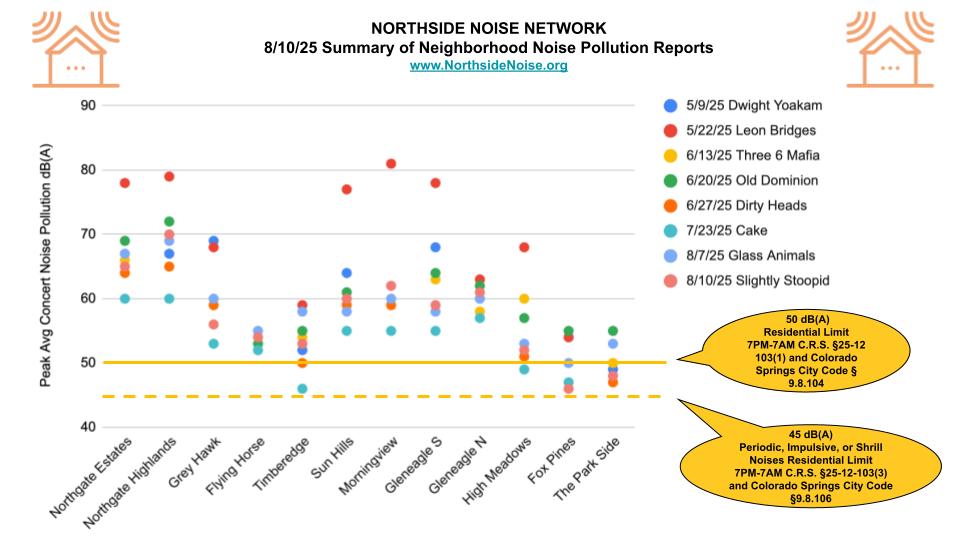
Resident noise monitoring: In contrast, resident volunteers continue to regularly publish new data about the neighborhood noise pollution they are experiencing with a network of 27 standardized sensors.
As shown in the summary below, the resident data shows that amphitheater noise pollution is consistently exceeding the 45-50 dB(A) Permissible Noise Limits in city ordinance and state law:
Results of Mayor Yemi's townhalls
In a testament to all the readers that turned out for Mayor Yemi’s Report Out community tour, the Tour Summary and District 2 Feedback Summary Report acknowledges concert noise pollution as a key issue in District 2:
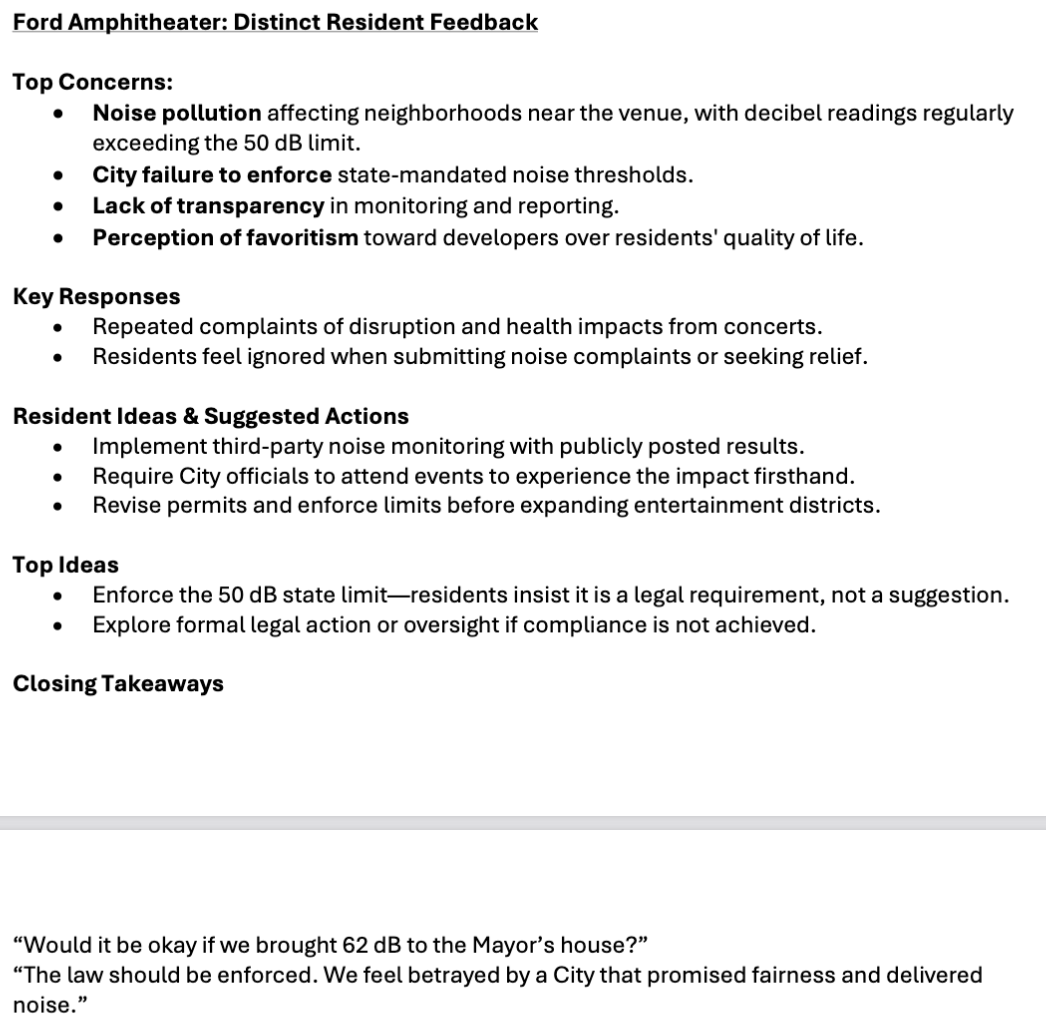
In the Telephone Town Hall with 2,600 residents, Mayor Yemi was asked if he has experienced the concert noise pollution that he is subjecting his residents to. He said he has not done so yet but that he would: “I’ll take you up on that challenge. I have not experienced it firsthand from a neighborhood.” We look forward to hearing about his experience.
Residents win in Yukon, OK
Underscoring the power of residents working together, leaders in Yukon, OK have announced that they will not be moving forward with development of an amphitheater there. VENU attempted to spin this as their decision, rather than Yukon’s.
VENU quarterly results
VENU reported Q2 results that showed revenue short of analyst estimates and net loss doubling as compared to the same quarter last year. Previously, one analyst noted increasingly financial complexity making it challenging to understand what is actually going on.
6/2/25: Top questions for Mayor Yemi
Ahead of Mayor Yemi’s Report Out Community Tour visit to City Council District 2 tomorrow, we’re sending a quick reminder of the key issues the 2025 concert season is forcing Mayor Yemi to confront:
Alarming Evidence: Why are residents continuing to document noise levels that dramatically exceed both the Permissible Noise Levels in City/State law, as well as the bounds of the 2025 City/VENU agreement? Something is wrong here.
Unmitigated Harm: Why are the opening concerts of the 2025 season continuing to generate HUNDREDS of noise complaints filed with the City? (And why is the media suppressing this story?)
Unfulfilled Promises: Residents were promised changes this season that would mitigate the disruption and harmful pollution they are experiencing. Why has nothing changed?
REMINDER: Mayor Yemi townhalls this week
This week, Mayor Yemi is holding meetings to “report on the progress the City has made in Mayor Yemi’s first two years in office and provides an opportunity for residents to engage with local elected officials and share input on the strategic direction of the City in the areas of public safety, infrastructure, housing solutions, economic vitality, and community activation.” We would encourage anyone harmed by concert noise pollution to use these forums to communicate directly with Mayor Yemi about what you are continuing to experience.
Events this week of interest to those affected by amphitheater noise pollution:
Tomorrow, Tue, June 3, 6-8PM: District 2 (where amphitheater is located) with Councilmember Tom Bailey Location: The Classical Academy North Campus Auditorium (975 Stout Rd.); register here
This Thu, June 5, 6-7PM; Citywide via telephone; register here
Thank you again to the resident that saw an opportunity to raise awareness of these meetings via door-to-door flyers and has made it happen!
Top Questions for Mayor Yemi
We previously asked readers to upvote the questions they would most like to see Mayor Yemi answer. As a resource for those selected to ask a question, we are highlighting the Top 5 questions that received the highest interest:
Respecting existing laws: Last fall, over 700 residents asked you to respect and enforce the City ordinance 50 dB(A) Permissible Noise Limit in the neighborhoods surrounding the amphitheater. Why did you choose to ignore this and, instead, sign a City/VENU agreement for the 2025 season that creates special rules for a special interest and sidesteps the City’s own noise ordinance? Why are you allowing City neighborhoods to be treated unequally? Why don’t all Colorado Springs citizens deserve equal protection under the law?
Apology: Are District 2 residents owed an apology for the concert noise pollution harm they have been forced to endure, both starting in 2024 and now continuing in 2025?
History: In the amphitheater’s approved development plan, VENU promised neighborhood concert noise would be 47 dB(A) or less. Last season, the City’s own data measured noise pollution at 60 dB(A), over 400% more sound power. Why did you sign an agreement for the 2025 season that fails to hold VENU accountable for the off-site noise level they originally promised?
Mental health: May is Mental Health month and the City is undertaking numerous efforts to reach out to citizens on this important topic. C.R.S. 25-2-101 states that excess noise often has an adverse physiological and psychological effect on human beings. Multiple third party sources have demonstrated that amphitheater noise pollution exceeds the Permissible Noise Limits found in city ordinance and state law. Why are you inflicting mental health anguish on the citizens that lived peacefully in the area before the amphitheater was built in the middle of residential neighborhoods?
Firsthand experience: Mayor Yemi, have you experienced firsthand the neighborhood noise pollution that is continuing to flood neighborhoods due to your decisions? If not, during which of this season’s loud concert(s) do you commit to visiting affected resident homes?
All questions available for reference here
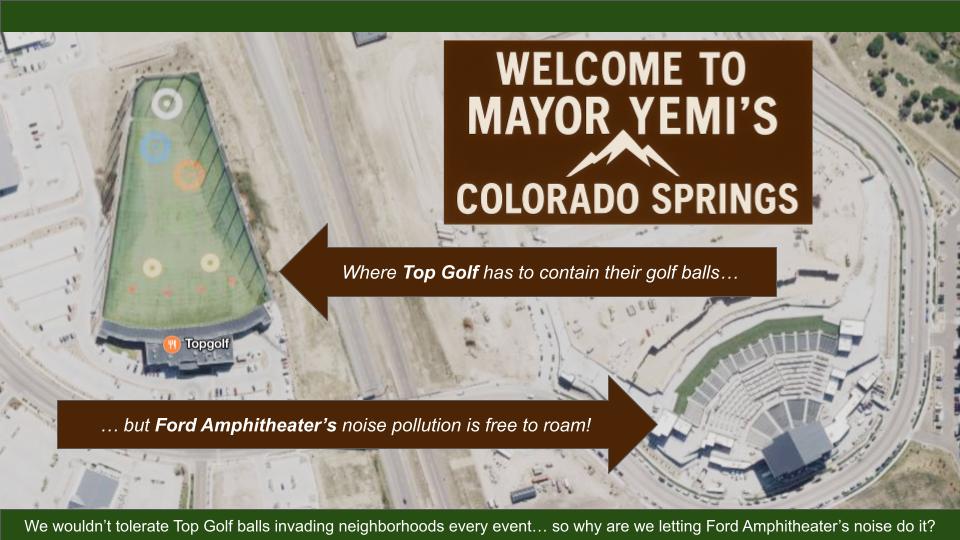
In Mayor Yemi's Colorado Springs
Speaking of Mayor Yemi, included below we’re providing some levity recently shared with us. A sad but true observation…
5/27/25: City's first 2025 noise pollution data & CO Supreme Court insights
We’re five concerts into the 2025 season and the reality for pre-existing residents surrounding Ford Amphitheater is coming in at full volume: the solutions promised for the 2025 concert season have not mitigated the pollution, pre-existing neighborhoods are still being flooded by harmful noise resulting in HUNDREDS of new noise complaints filed with the City, and – alarmingly – residents continue to document noise pollution levels that egregiously exceed the city and state noise limits that should be protecting them.
Mayor Yemi faces a stark choice: will he recognize this crisis and take new action toward real enforcement and actual solution to protect his residents – or is he willing to sell them out in favor of a for-profit corporation? This is a critical moment for Mayor Yemi to respond and demonstrate real leadership on this issue. The voters are watching – and are expecting to hear from him on this at his Report Out Community Tour townhalls next week.
Latest noise pollution data
City noise monitoring: Late last Friday (5/23, 3+ weeks after the first concert of 2025), the City released its first tranche of 2025 noise pollution data covering the first three concerts of 2025:
According to the City, “According to the data, Venu is not subject to any penalties that are outlined in the January 2025 agreement made between the City and Venu.”
The third-party data the City has publicly posted so far to support its “in compliance” conclusion is woefully inadequate (just ~30 min of noise monitoring from 4/30 Jason Isbell and just ~20 min of noise monitoring from 5/5 Seether). Without third party noise measurement data from the full concert, it is impossible to corroborate VENU’s noise measurement data and know the actual levels of neighborhood noise pollution and/or compliance.
These data sets raise concerning questions:
Why are residents continuing to document noise pollution levels that dramatically exceed both the Permissible Noise Levels in City/State law, as well as the bounds of the 2025 City/VENU agreement?
Why isn’t third party data from the entire concert period (and preceding sound check) being released? What is being missed or excluded?
Why is the City allowing neighborhood noise monitor data to pass through VENU in the first place? This is akin to doing traffic enforcement by having trucking fleets submit a list of their violations: incentives are not aligned.
Why is the City taking weeks to turn around data? What is being done to the data in the intervening time?
Further, if everything is alright, why are the opening concerts of the 2025 season continuing to generate HUNDREDS of new noise complaints filed with the City?
What is being done to investigate, substantiate, and resolve those complaints? Where is the response from Code Enforcement?
Is the City fulfilling its legal duties to enforce Permissible Noise Levels in City ordinances in neighborhoods surrounding the amphitheater? Are District 2 concert noise complaints receiving the same treatment as noise complaints in other neighborhoods in the City?
Where is the Mayor’s concern? When did he personally listen to the concert noise at the home of an affected citizen? Is Mayor Yemi okay with the harm being experienced, particularly by vulnerable neighbors including families with autistic children, veterans with PTSD, disabled individuals reliant on service animals, and more?
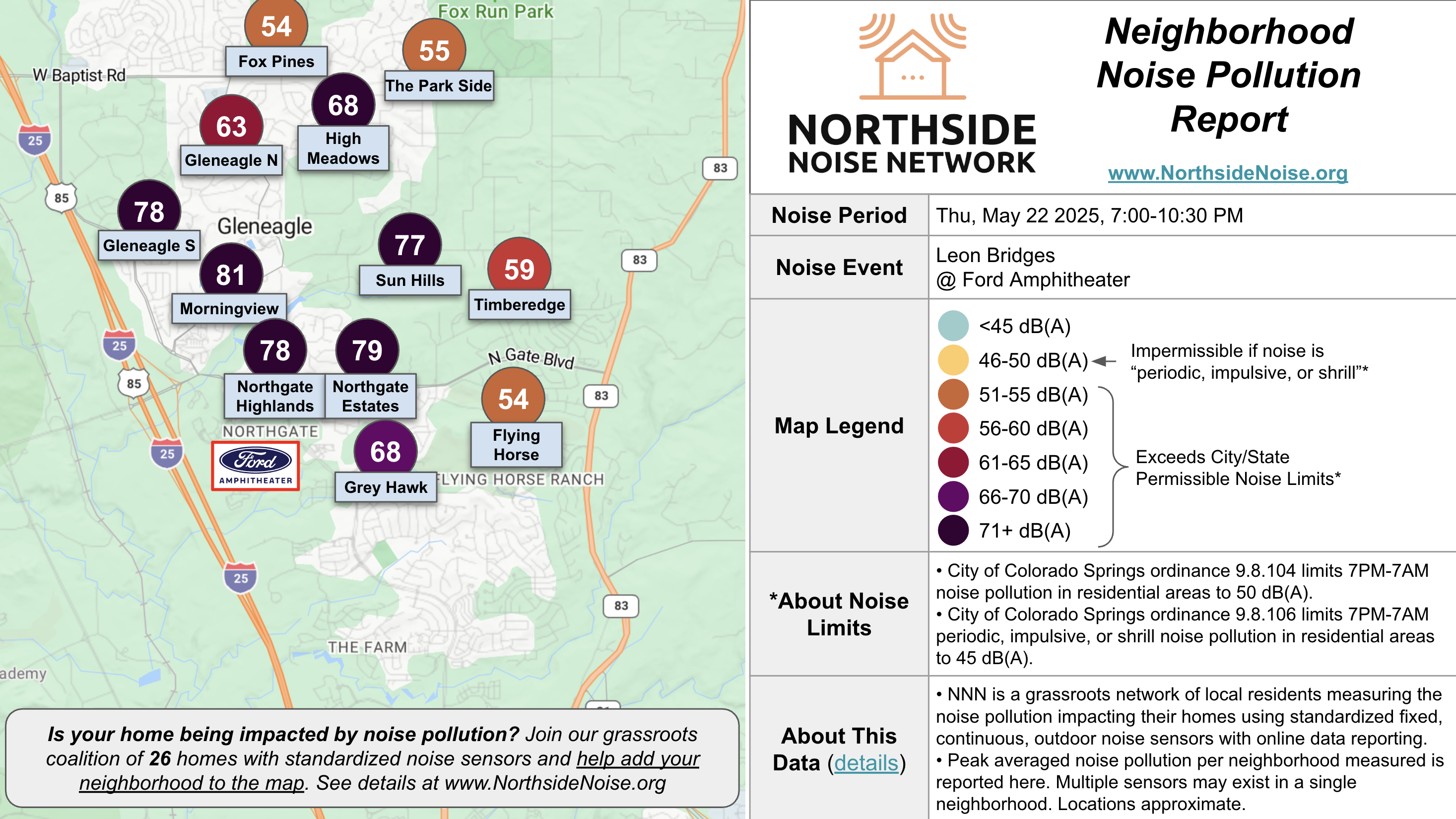
Resident noise monitoring: This season’s grassroots effort by residents to document the noise pollution they are experiencing by deploying standardized, fixed, continuous off-the-shelf noise sensors across affected neighborhoods is continuing to publish data.
Concerningly, during last week’s Leon Bridges concert (Thu, 5/22; note this concert not included in City’s data release above), residents documented the worst level of noise pollution recorded yet this season – with some neighborhoods affected by pollution reaching 70-80 dB(A)!
REMINDER: Mayor Yemi townhalls
Mayor Yemi is holding upcoming meetings to “report on the progress the City has made in Mayor Yemi’s first two years in office and provides an opportunity for residents to engage with local elected officials and share input on the strategic direction of the City in the areas of public safety, infrastructure, housing solutions, economic vitality, and community activation.” We would encourage anyone harmed by concert noise pollution to use these forums to communicate directly with Mayor Yemi about what you are continuing to experience.
Events of interest to those affected by amphitheater noise pollution include:
Tue, June 3, 6-8PM: District 2 (where amphitheater is located) with Councilmember Tom Bailey Location: The Classical Academy North Campus Auditorium (975 Stout Rd.); register here
Thu, June 5, 6-7PM; Citywide via telephone; register here
Thank you to the resident that saw an opportunity to raise awareness of these meetings via door-to-door flyers and has made it happen! Flyer linked here; feel free to share with your neighbors.
Also don’t forget to upvote the Top 5 questions you would most like to see answered. Prior to the events, we will report out a summary of highest interest items as a resource for those that are selected to ask a question.
CO State Supreme Court Arguments
In what could be the best news for affected residents so far this year, during recent Hobbs oral arguments the Colorado Supreme Court appeared skeptical of the loophole the City-VENU industrial noise complex is currently using to skirt the state’s Noise Pollution Law (that, similar to air and water pollution legislation, was designed to ensure all Coloradoans enjoyed a minimum level of protection from noise pollution).
As reported by Colorado Politics, Supreme Court justices pointed to the obvious solution (turn it down) that we’ve all known all along:
“Members of the Colorado Supreme Court attempted on Thursday to decipher a 38-year-old amendment to the state's noise pollution law to determine if local governments may permit any for-profit entity to host events on private property that exceed the statewide decibel limits.
In doing so, multiple justices were openly skeptical of the city of Salida's representation that abiding by Colorado's noise limitations for entertainment events would decimate the Salida Creative District.
‘It seems to me it doesn’t have to be such an awful outcome. It just means events have to occur at lower decibel levels and arguably everyone’s a winner,’ said Justice William W. Hood III at oral arguments.”
The Supreme Court also shut down the “this is about culture and vibrancy” straw man distraction that we’ve seen VENU use before:
“The ‘heart’ of the case, argued Romberg, is, ‘What is a locality's ability to bring arts into their community?’ Chief Justice Monica M. Márquez cut her off to say the narrow issue was about noise.”
Finally, the Court also held noise polluters to account for the extremism of some of their arguments:
“After Romberg suggested any other interpretation of the amendment was unreasonable, Gabriel pointed out a three-judge Court of Appeals panel and one dissenting appeals judge in the Salida case all sided against the argument the city was making. ‘You're asking us to conclude four judges on the Court of Appeals are unreasonable. That’s troubling,’ he said.”
It will still be months before the Court rules on this case and a favorable ruling may not fully address the harm being experienced in Colorado Springs – but it would be a great victory for the rule of law and leave the City with no excuse for failing to protect its residents.
Volunteers Wanted
We’re looking for trusted volunteers to help with the following; please reach out via
Social media coordination: we are seeking help from someone comfortable working on a computer to help with some social media tasks
In-person events: we are seeking help from someone interested in helping organize a focused series of in-person events in response to this summer’s continued disruption
5/12/25: Latest noise pollution data & new Mayor Yemi meeting
We’re three concerts into the 2025 season and the evidence is coming in at full volume: Ford Amphitheater neighborhood noise pollution isn’t fixed and harmful concert noise pollution continues to flood pre-existing neighborhoods. It’s increasingly clear that the two stories told by the City-VENU noise industrial complex over the past year (#1: “please be patient, we’re doing this for the first time and are trying to figure out how to tune our system” and #2: “we’ll build some new mitigations and it will be better next season”) have not mitigated the harm residents are continuing to experience (in fact, reports from some affected areas say this season is worse than last). The evidence, outrage, and harm from the polluters continues to grow with every disruptive concert.
Residents have been placed in a situation much like the last time you were on a flight and someone a few rows ahead chose to watch a video on their phone at full volume with no headphones: it’s obnoxious, it’s selfish, and it needlessly invades the lives of others (e.g. “Your video is not the problem; your lack of headphones is”). Many airlines have policies against this and take action to enforce those rules. Amphitheater neighbors should be similarly protected by city and state noise pollution laws but enforcement appears currently absent and one for-profit business is being allowed to hijack the daily life of many. And worse than a short flight, residents have no immediate option to get off and are being dragged through this experience night after night – with 20+ more events scheduled for this season alone.
Mayor Yemi, our City Council, our County Commissioners, and other leaders now face a stark choice: will you restore order onboard the 80921 aircraft – or will you hide from the issue, pretend it’s not occurring, or – even worse – attempt to rationalize it as acceptable behavior? Voters are watching closely to see which of our leaders has a backbone in response to this continued invasion that is creating real impacts on real people (and if leaders haven’t yet experienced it firsthand, that’s the first thing they should do). Now is a key moment for leadership: as we saw last season, the harm and fracturing of the community will only grow if this remains unaddressed.
As reported further below, important opportunities are coming up for residents and leaders to speak out on this issue:
Latest noise pollution data
City noise monitoring:
Data: today marks 12 days since the inaugural 2025 concert (4/30) and we have not yet seen any data from the City’s/VENU fixed monitoring stations (including three new neighborhood stations) or the City’s outside consultant that is providing temporary noise monitoring augmentation.
Conclusions: We also have not yet been made aware of any determination on whether these first three concerts were compliant with the 2025 City/VENU agreement AND existing city noise ordinance.
We would urge the City to immediately update its Ford Amphitheater webpage (which Mayor Yemi promised to be a clearinghouse of key information on this matter) with all sensor data, maps, calculations, and determinations.
Resident noise monitoring:
In contrast to the delays above, this season’s grassroots volunteer effort by residents to record standardized data on the noise pollution their homes are experiencing is continuing to publish insights, including from the most recent Fri 5/9 concert. From that group’s organizers:
Below, we’re again sharing a representative noise graph (from a different sensor than the 5/2 Seether concert) highlighting the extended impact of both the sound check and the concert.
At this location, concert noise pollution peaked at 65 dB(A), which is 560% more sound power than the 50 dB(A) Permissible Noise Level
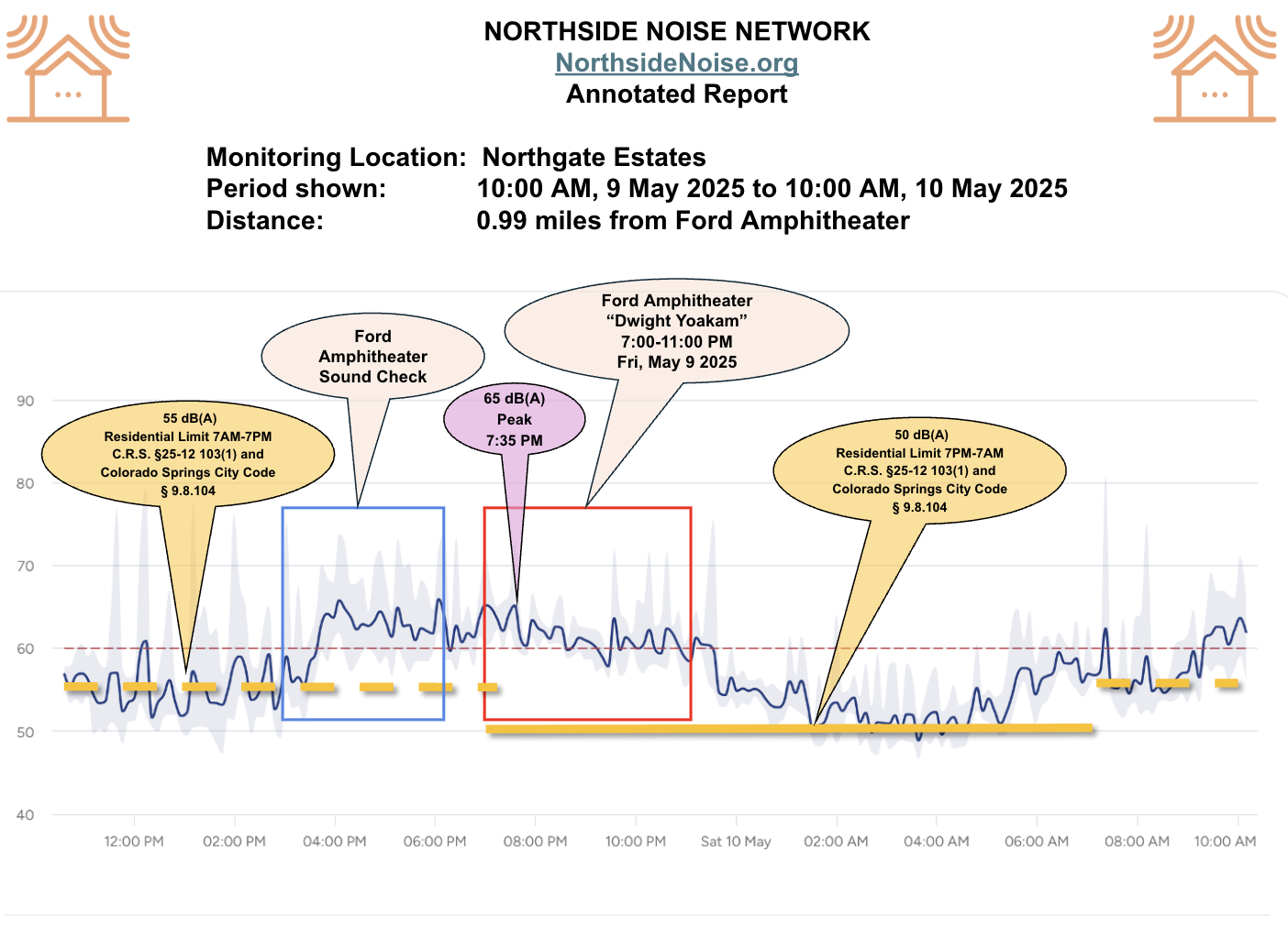
We’re also sharing our inaugural Neighborhood Noise Map, showing peak noise pollution recorded during the 5/9 concert in each neighborhood monitored during this event. This data shows the widespread geographical impact and elevated level [numerous neighborhoods 60+ dB(A)] of this noise pollution, miles from its source.
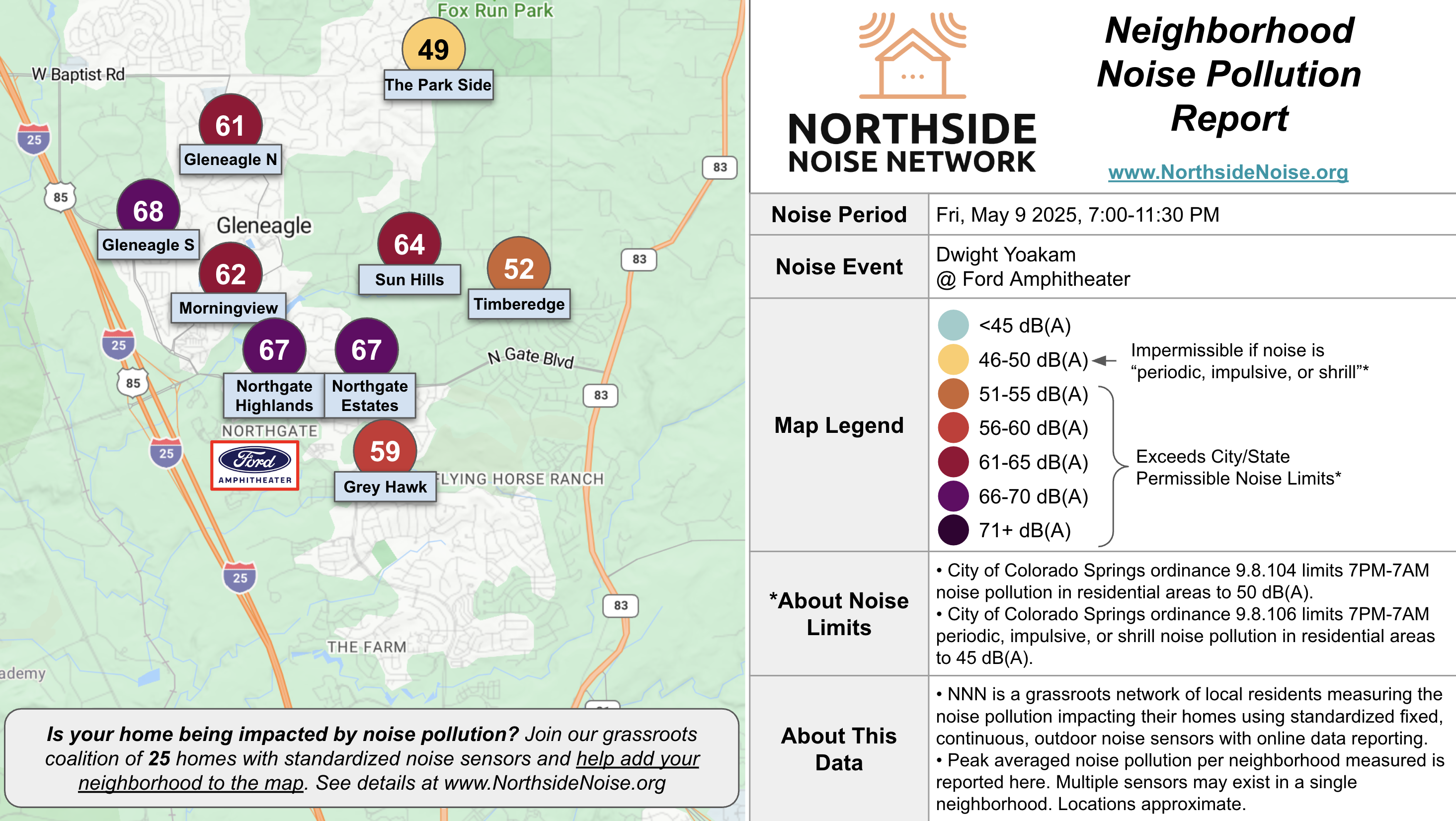
NEW: Mayor Yemi announces townhalls
Mayor Yemi has announced a series of townhalls across the city during May & June. According to the City: “The seven-stop tour includes a report on the progress the City has made in Mayor Yemi’s first two years in office and provides an opportunity for residents to engage with local elected officials and share input on the strategic direction of the City in the areas of public safety, infrastructure, housing solutions, economic vitality, and community activation.”
Similar to the compelling testimony by amphitheater neighborhood residents at his December listening session, we would encourage anyone harmed by concert noise pollution to use these forums to communicate directly with Mayor Yemi about what you are continuing to experience.
Events will be held in every council district including:
Tue, June 3, 6-8PM: District 2 (where amphitheater is located) with Councilmember Tom Bailey Location: The Classical Academy North Campus Auditorium (975 Stout Rd.); register here
Thu, June 5, 6-7PM; Citywide via telephone; register here
Based on earlier feedback and previous forums, linked here we’ve compiled a starter list of questions that could be of interest. Please upvote the questions you would most like to see answered. We will report out a summary of highest interest items as a resource for those that are selected to ask a question.
Reminder: questions/comments on this topic can be submitted to Mayor Yemi anytime through his new “comment card” inbox, though it remains unclear if any response will be provided.
Feel free to share this with affected neighbors and invite them to engage on the important topic about the future of their community.
Reminder: City Council meets tomorrow (Tue)
The City Council will hold its first meeting since the start of the 2025 concert season tomorrow Tue, 5/13 at 9AM at City Hall.
As previously reported, the new Council has limited citizen participation and has now pushed citizen comment to the end of the agenda (see “13. One Hour of Citizen Discussion for Items not on Today's Agenda per City Council Rules”). samuel.friedman@coloradosprings.gov may be able to advise those wishing to comment on the new Council’s procedures and when this agenda item is actually likely to occur.
Some of the questions above for Mayor Yemi’s upcoming forums could also be relevant here.
Reminder: State Supreme Court arguments this week (Thu)
This week, the Colorado Supreme Court will hear arguments in Hobbs, the case to resolve conflicting rulings from lower courts about loopholes municipalities can use to escape jurisdiction of the state Noise Pollution Law.
Hearing will be held 9:15AM this Thu, May 15 in at Falcon High School in Peyton. Oral arguments are typically livestreamed, though we have not heard if this session occurring out of the court’s usual building will impact that capability.
Readers may be interested in the petitioner’s brief detailing the issues at stake. To share one memorable excerpt: "Just as important though, Hobbs’s reading of the exemption will maintain the statewide scheme and ensure the private rights created in the Act still have meaning. This case perfectly illustrates why this is so important. Here, an unelected official issued a blanket permit to a single private for-profit bar that allowed it to hold more than 50 outdoor concerts over a five-month period and emit noise 3,000% higher than the maximum level allowed under statewide standards. Indeed, it’s no secret why special interests like Amici Notes Live are lining up in support of judicializing this change to the Act. Building outdoor concert venues in the middle of residential areas and convincing unelected officials to approve raucous concerts is much easier than lobbying the general assembly for sweeping changes to state law. The court should reverse.”
Social media coordination
We’re looking for a trusted volunteer comfortable working on a computer to help with some social media tasks. If you’re interested in helping, please reach out via contact form.
Hear their voices
We conclude with a sampling of what real residents are saying about the real impacts they experienced from the Fri 5/9 country concert:
City complaints:
ENF25-02394: “71 dBA noise from the amphitheater in my backyard. This seems to be government sanctioned criminal behavior.”
ENF25-02393: “Can hear music at our house near BAPTIST ROAD already and the night is still young.”
ENF25-02396: “... Now it is past 10:30 pm and we cannot sleep through the noise. It comes in through my house even with all the windows closed. Unable to sleep. This is way too loud. We live in Flying Horse, Saratoga Village. The noise is violating my private property.”
Nextdoor (please report to the City to formally document these impacts!)
Northgate Highlands: video evidence of noise pollution peaking at 70 dB(A) at 10:55PM on resident’s back porch
Northgate Highlands: “So loud! We were having a family reunion and it was embarrassing”
Stonewater: “... I was about to go to bed around 9:30pm is when all the noise started. It’s almost like that is when the main act starts and they turn up the sound?? You can almost hear whoever is on the microphone speaking very clearly.”
Falcon’s Nest: “10:50 and still coming in loud and clear. So much for sound mitigation!”
Gleneagle: “Tonight I can’t even lay in bed because the drums and the annoying bass are vibrating my bed. I don’t understand how this is still allowed.”
Gleneagle: “We live just off Gleneagle, near Antelope Trails and last night was the loudest we have experienced. After 10:30 my 12 year old came and asked when they would shut down for the night because it was so loud and she was trying to go to sleep.”
Gleneagle: “We are 3 miles away ... All the way by Fox run Park & the drums are so loud & I can hear the lyrics clearly enough that it sounds like my next door neighbor is having a party.”
Sanctuary Pointe: “We can hear it loud and clear in Sanctuary Pointe - doors and windows closed. We moved to this area because it was peaceful.”
Pleasant View: “I can hear it clearly right now up just off of Baptist Rd… I am over 3 miles away right now with my windows closed and it sounds like just down the street. This has to stop.”
May our leaders remember: "The time is always right to do what is right." – Martin Luther King, Jr.